
Average time of the processes in body repair

In auto body repair, no two breakdowns or maintenance are the same.
All repairs come from an accident, deficiency in the maintenance of the bodywork, the passage of time or environmental conditions. And no two situations are the same. But the sheet metal and paint shop does well to have a general understanding of body repair times in order to give the importance it deserves to each phase, as well as the materials used and which help to optimize these times.
For this reason, at Daevi we have made a graph where we specify the percentage of expected time that is used in each process of the repair.
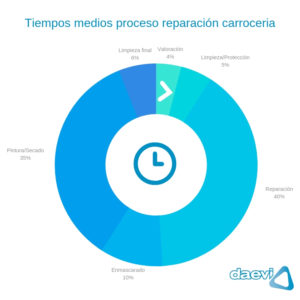
It should be borne in mind that we have taken estimated percentages of an average quick body repair as a basis.
Let's see in detail the percentage of time for each phase.
Time invested in each body repair process
Damage assessment
This first phase we estimate occupies a 4% of total repair, includes the study of the damages to be able to assess the processes that are required, inform the person in charge who will carry it out, if the request for spare parts is necessary and prepare the necessary material for the repair.
Cleaning and Protection
This phase requires approximately 5% of time total and involves cleaning the area that allows focusing on the area where the repair will be carried out, as well as applying a correct protection of both elements adjacent to the repair and interior elements of the vehicle, which will prevent the mobilization of the vehicle by operators dirty the interior of the vehicle thanks to protection covers specific.
Repair
At this stage, we assign a 40% of the time under repair approximately.
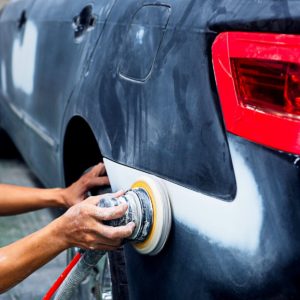
Includes body repairs such as dents, scratches and bumps. Depending on the degree of damage, we must talk about the 3 types of use of abrasives:
1. Light damage: Requires polishing and polishing to repair minor paint defects or minor scratches and restore shine to surfaces.
2. Medium damage: Requires stripping the surface to remove the paint when the origin is considerable scratches or there has been a previous deep repair of sheet metal gradually using various abrasive discs of different grains.
3. Serious damage: Requires a roughing of sheet metal to match the body surface when there have been deep dents, sheet breakage requiring welding, or there is advanced corrosion.
Masked
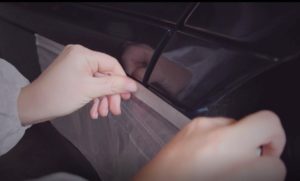
This process carries a 10% of the total repair approximately, and consists of completely sealing the vehicle before the paint job.
It begins with a general protection to seal the grooves and unevenness of the body with technical tapes (masking tape, plastic with tape, adhesive strip, rubber tape...). It is a very meticulous and essential work that helps to achieve a perfect finish minimizing the risk of subsequent defects.
Painting and drying
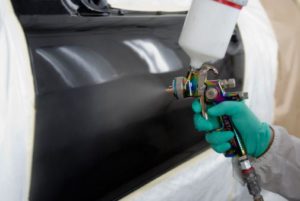
The painting process can represent a 35% of the total repair and includes the application of primers, lacquers and varnishes. Each of these applications involves specific drying times, so painting is also considered to be one of the longest vehicle-retaining processes in the workshop, which can lead to “bottlenecks”.
Final cleaning
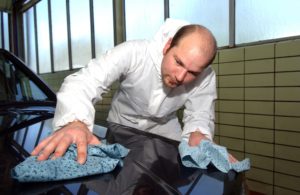
In this last phase approximately 6% is used the repair time and involves a deep cleaning to visually check the worked area, as well as the rest of the vehicle, to find small paint defects and correct them, as well as perform a vehicle cleaning that brings added value to the repair and is an act highly valued by the customer.
We remind you that these percentages are estimates, since each repair is different and the values may vary, but it is an average value that emphasizes the time invested in each phase of the repair.
There are those who believe that it is necessary to invest more time in masking to ensure that the paint job does not create subsequent defects that require touch-ups (and therefore more time), and others prefer to spend more time on final cleaning adjusting the finish and offering the client a more attractive result.
Be that as it may, it is essential to have the right products for each process.
If you use the annexes Daevi You will have a part of the success of the work corresponding to the process of masking and temporary protection.
If you liked this article, you cannot miss these: